
“Peace on earth will come to stay when we live Christmas every day.” Helen Steiner Rice
Christmas Eve, 1914 – Ploegsteert Wood, Belgium: Charlie Brewer, a 19-year-old British lieutenant with the Bedfordshire Regiment, shivered in the 3-foot-deep by 3-foot-wide trench. His uniform was covered in mud. What a way to spend Christmas.
For the past three months, he had been fighting the Germans in Belgium. At about 10 p.m., he thought he heard someone singing. He listened. There it was again. The song pierced the silence of the clear, cold, moonlit night. The words were not familiar to the young soldier, but the tune certainly was: Silent Night.
Charlie slowly raised his head above the sandbags and saw an amazing sight. Less than 100 yards away, a Christmas tree was shining above the wall of the German trench. Gazing through the maze of barbed wire and down the line of trenches, Charlie saw a string of Christmas trees lit with candles. When the German soldier finished singing Stille Nacht, the British soldiers shot flares and applauded. Then they sang the English version of the beloved carol.
World War I had begun six months earlier in late June 1914, with the assassination of Austrian Archduke Franz Ferdinand. After his murder, Austria threatened war on Serbia, and within a week, Germany declared war on Russia and France. On August 4, following Germany’s attack on France and Belgium, England declared war on Germany. The newspapers predicted the war would be over by Christmas, but it had only escalated. By the holiday, more than 600,000 soldiers were dead in Europe.
The main theater of fighting during the war was along the Western Front – a 400-mile fortified trench line that started in southern Germany, turned west and then north through France and Belgium, and ultimately to the North Sea. In a matter of months, the fighting had bogged down to trench warfare, with soldiers camped in trenches lined with barbed wire, sometimes only 100 yards apart, all along the front.
Pope Benedict XV called for a Christmas truce, but military leaders rejected his proclamation. German, French, and British senior military officers issued orders that any soldier caught fraternizing with the enemy would be severely punished, up to and including court martialed.
No one is sure where the impromptu Christmas Truce began or how it spread, but all along the Western Front, soldiers decided to stage their own spontaneous Christmas truce. Almost always, it was the Germans who instigated the peace with songs and signs.
When dawn broke on Christmas morning in Ploegsteert Wood, the German soldiers cautiously climbed out of their trench and walked across No Man’s Land to greet Charlie Brewer and his fellow soldiers, men they had been trying to kill only hours before. The soldiers chatted and laughed like they were old friends.
The truce allowed the soldiers an opportunity to bury the dead, many of whom had been lying frozen in No Man’s Land between the trenches for weeks. It was the first order of business, and enemies labored side by side to complete the somber task.
Most often, the truce began on Christmas Eve with Christmas carols. At Flanders in northern Belgium, to begin the cease-fire, German soldiers held up a sign, “Tomorrow, we no shoot, if you no shoot.” In France, German soldiers came out of the trenches shouting, “Merry Christmas!”
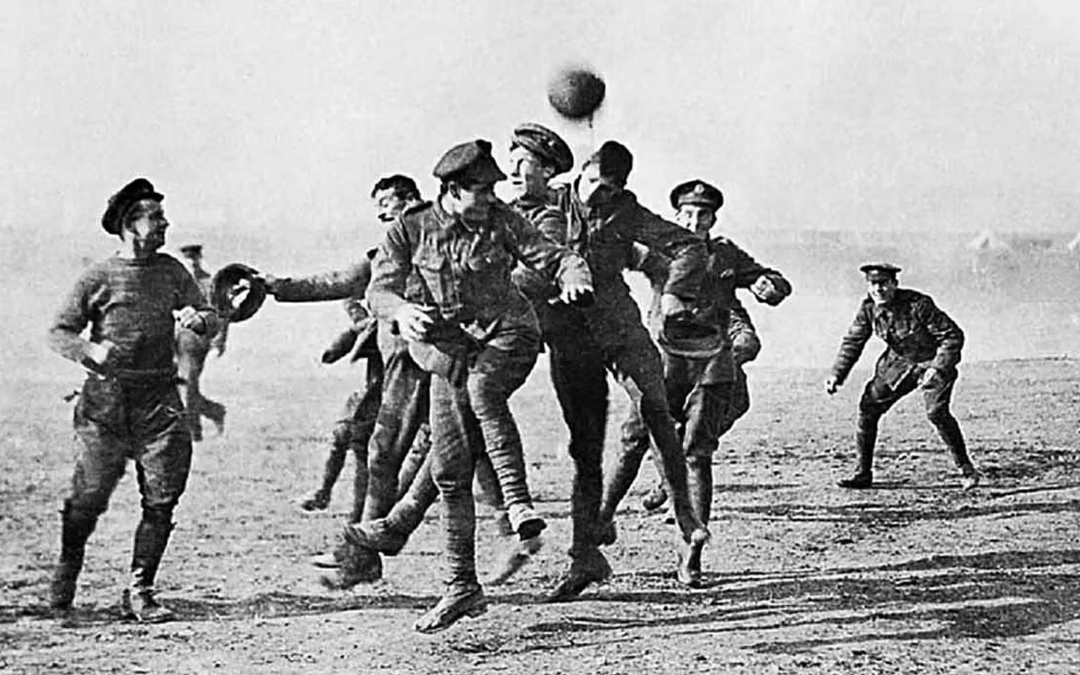
Soldiers played improvised soccer games in the afternoon using a can for the ball. The games generally ended in a tie. In one location, there was a pig roast. All along the front, soldiers exchanged songs and gifts of cigarettes, tins of sweets, food, beer, wine, hats, and buttons.
As the sun set on Christmas Day, soldiers retreated to their trenches. At midnight, the fighting resumed. At Houplines, in northern France, Charles Stockwell, a British captain, fired three shots in the air and raised a sign that read “Merry Christmas.” His German counterpart raised a sign that said, “Thank you.” The two men saluted each other. The German fired two shots in the air, and the war was on again.
The guns of World War I would not be silent again until the signing of the armistice agreement on November 11, 1918. Though the death toll was never accurately known, it is estimated that more than 10 million men died in World War I in Europe.
Military orders and threats of being court-martialed couldn’t stop Christmas from coming for soldiers along the Western Front on that Christmas Day 1914. Transformed by the magic of Christmas, they laid down their guns, stepped out of their trenches, and for a few precious hours, God was near. On ugly, war-torn battlefields along the front, the Prince of Peace was there.
An amazing story. Thanks Pete. Happy New Year!
I think about what these soldiers had to endure and I’m sure they wondered where is God in all this. A glimpse of his goodness shown through that day. One of our locals made it home. Harry “swamp” Hudson was wounded and received a Purple Heart. He was a good person who treated me like one of his own.