
“God guides us, often by circumstances. They are not haphazard results of chance, but the opening of circumstances in the direction in which we would walk.” F.B. Meyer
Parowan, Utah – 1890s: Alma Wilford Richards was named after a prophet of the Church of Latter-Day Saints. His Mormon parents were sent by Brigham Young to help settle southern Utah. They settled in tiny Parowan, population 1,100. After being bullied by a teacher, Alma quit school at 14 to become a farm hand. He worked the land and helped in his father’s mercantile store.
A 1908 winter storm and a chance meeting with a college professor in a hotel in Lund, Utah, changed the course of the 18-year-old high school dropout’s life. Because of the storm, rooms were scarce, and Alma found himself sharing a room with Thomas Trueblood, an oratory professor at Michigan State, who was in route to Los Angeles. After Alma shared his dream of traveling the world, Trueblood told him that education was the key to unlocking his dreams and encouraged him to return to school.
The encounter with Trueblood so inspired Alma that a few weeks later, he rode his horse to Beaver, Utah, moved in with his sister and her husband, and enrolled at Murdock Academy as a ninth grader. After a year, Alma transferred to Brigham Young Prep School, located on the Brigham Young University (BYU) campus in Provo, Utah.
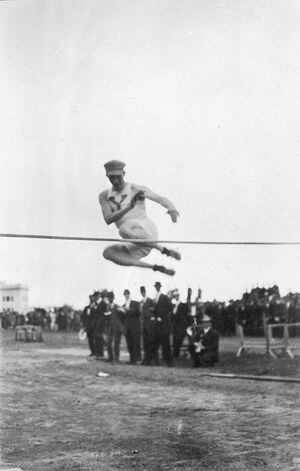
While playing in a pickup basketball game, Alva’s jumping ability caught the eye of BYU track coach Eugene Roberts. “Son, you got a minute?” Roberts asked. He walked with Alma to the team’s high jump pit and set the bar at six feet. “Think you can jump over that bar?” the coach asked. Alma shrugged. He had never high jumped, but he backed up, took a running start, and easily cleared the bar.
Roberts shook his head in amazement, not sure he believed what he had just seen. The BYU high jump record was 6’ 2”, and the world record was just 5 inches higher. “Son, where did you learn to jump like that?” Roberts asked. “Chasing jackrabbits and jumping fences on the farm,” Alma replied. Coach Roberts invited him to join the BYU track team.
“Coach, I’m not a student at BYU”, said Alma. “What school do you attend?” inquired Roberts. Alma said, “I’m still in high school.” Roberts was astounded. “Son, if you’ll work hard with me for the next 18 months, you can go to the Olympics in Stockholm, Sweden,” Roberts said. “What’s the Olympics?” asked Alma.
In May 1912, Alma rode the train to Chicago and qualified for the U.S. Olympic team as a high jumper. A month later, he sailed from New York with fellow teammate George Horine, a Stanford University student and the world record holder in the high jump (6’ 7”), and the rest of the U.S. Olympic team to Sweden.
The high jump competition took place on July 7 and 8, with more than 30 high jumpers from 20 countries competing. By the time the bar was raised to 6’2,” there were four jumpers remaining: Horine, legendary Olympian Jim Thorpe, Hans Liesche representing Germany, and an unknown high school junior from Parowan, Utah. To the surprise of many, Horine and Thorpe failed to clear the height.
On their first two tries at 6’ 4”, both Liesche and Alma failed. Before Alma’s 3rd and final attempt, he walked away from the pit, and before 24,000 fans, he knelt and prayed, “God give me strength to do my best and to set a good example all the days of my life.” The gesture seemed to rattle Liesche, and his final attempt was his worst. Then, 22-year-old Alma surprised everyone, including himself, by successfully clearing the bar, winning the Gold Medal. He was the first person in Utah to ever win a gold medal.
Following ticker-tape parades in New York City and Provo, Alma finished high school and graduated with honors from Cornell University in New York, where he had a celebrated track-and-field career. He attended graduate school at Stanford University, then law school at the University of Southern California. Alma chose not to practice law. Instead, he became a science teacher at Venice High School in Los Angeles, where he taught for 32 years before retiring.
Alma Richards is a member of the Utah, Brigham Young, and the U.S. Track and Field Halls of Fame. “A chance meeting in a small railroad hotel during a snowstorm with Professor Trueblood in 1908 changed the course of my life,” Alma later recalled. “It also showed me how high I can jump.”