
“Give thanks in all circumstances, for this is God’s will for you. I Thessalonians 5
October 1620 – North Atlantic Ocean: Freezing water rained down on the frightened passengers as they huddled below deck in semi-darkness, the ship’s hold lit only by a few candles. Rough seas made it impossible for the crew to cook hot meals. The daily fare consisted of moldy cheese, worm-infested biscuits, pickled pork, and salted fish. To make things worse, the rude crew mocked the religious dissenters whenever they gathered to sing and pray.
On September 6, 1620, the Mayflower set sail from Plymouth, England, bound for the New World. The ship carried a crew of 30 and 102 passengers, comprised of religious separatists, also known as Pilgrims, from Holland, and a few merchants from London. Unlike earlier voyages, which consisted of only men, the Mayflower passenger list included 34 women and children.
It was the worst North Atlantic storm that 50-year-old Captain Christopher Jones had ever seen. For several weeks, intermittent gales kicked up 30-foot waves and pounded his small ship. Having spent half his life at sea, Jones was now cautiously optimistic that his 132-foot freighter-turned-passenger ship could make the crossing. He took some comfort in remembering that other ships were making this same journey each month.
The passengers had been told that if they survived the voyage, there would be savage Indians to worry about. And they knew about the tragedy at Jamestown, in the Virginia colony, more than a decade earlier, when 1,000 of the 1,200 pioneers died in the first year from scurvy, pneumonia, and the brutal winter cold. Naysayers back home predicted that would also be their fate.
After several weeks of persistent, intense storms, Captain Jones presented Pilgrim leaders, William Bradford, who would later serve as governor of the Plymouth Colony, and William Brewster, a senior elder in the church, with two options: They could turn around and sail back to England or take the risk and sail on to the New World.
For the Pilgrims, turning back was not an option. They had sold their houses and left their jobs, friends, and families behind. They dreamed of a new life, free of religious persecution, and a land to call their own, provided by a government grant on the Atlantic coast.
Although confident that God had called them on this journey, they often wondered whether they had been foolish to leave their established lives in Europe. Finally, on November 9, 65 days out of port, the Mayflower landed on the coast of New England near Cape Cod, Massachusetts.
The Pilgrims named their new settlement Plymouth. By early December, having completed a common building, the men began construction of individual houses. A brutal winter and poor nutrition took their toll on the unprepared settlers. In December, nine people died of scurvy and influenza, 10 more died in January, and four months after arriving, there were 49 graves on the hillside overlooking the settlement. Fifty-three hardy souls remained.
Desperate for help, the Pilgrims tried for several months to contact nearby friendly Indians. In late March, in answer to prayer, an English-speaking Indian named Squanto walked into the small settlement and welcomed the settlers to their new land. He showed them how to catch fish and eels for food and taught them how to plant corn using fish as fertilizer.
By May, the settlement consisted of seven family houses, four common buildings, 20 acres of corn, and several garden plots. In the fall, the corn harvest was plentiful. On the first anniversary of their arrival in the New World, newly elected Governor William Bradford declared that a day be set aside for giving thanks to God for a successful harvest.
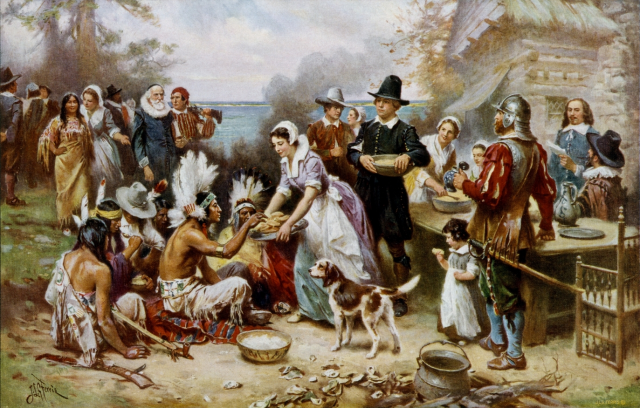
Almost 90 Indians from the Wampanoag tribe joined the 53 survivors at the first Thanksgiving celebration. There was plenty to eat: deer, turkey, fish, carrots, cucumbers, cabbage, turnips, strawberries, plums, and cherries were all in abundance. The celebration of gratitude lasted three days.
A few months after the celebration, 35 more pioneers arrived from England. The worst was over for the small settlement. These hearty survivors had been knit together by their struggles and unified by their dream for a better life. The settlement prospered, and by 1700, the population of the Massachusetts colony numbered 250,000 people.
In 1863, President Abraham Lincoln proclaimed the last Thursday in November as National Thanksgiving Day. Today, besides the U.S., only Canada, Liberia, and Grenada celebrate a National Thanksgiving Day. “Perhaps no custom reveals our character as a nation so clearly,” said former President Ronald Reagan, “as our celebration of Thanksgiving Day.”
Those Pilgrims had a lot grit. I doubt I would have survived the boat ride. I hate cold weather. Man, the Pilgrims were tough. Thanks Pete