
“You are never too old to set a new goal or dream a new dream.” Les Brown
1995 – Dallas, Texas: Carl Henry, a literacy recruiter, knocked on the door of the small, dilapidated house in south Dallas. He informed the older gentleman who answered the door that adult literacy classes were being offered a few blocks away at the old high school. George Dawson responded, “I don’t do nothing much anymore but sit around. The fish ain’t biting. I think it is finally time for me to learn to read. Let me get my coat.”
George Dawson was born in 1898 in Marshall, Texas. He remembered his grandmother’s story of the day the plantation master called the slaves together and told them the South had lost the war, and they were free. George’s grandfather bought 40 acres for $0.50 an acre. Over the years, the farm grew to 320 acres.
George started to work when he was 8 years old. There was never time for school, so he never learned to read and write. He picked cotton, worked in a sawmill, built levees on the Mississippi River, and worked for the railroad laying crossties. In 1938, he got a job at Oaks Farm Dairy in Dallas repairing machinery. He worked there for 25 years before retiring at age 65 in 1963. George did yard work for people in the community until age 90, then lived on his $520-a-month social security check.
George kept his inability to read a secret his entire life. As a youth, he learned to recognize “Whites Only” signs, and he was always ashamed to sign his name with an X. He was embarrassed that he couldn’t read menus or the newspaper. On several occasions at the Oaks Farm, George was passed over for a promotion because he could not complete the paperwork.
George and his wife, Elzenia, had seven children. Every night, George had his children show him their completed homework. He would stare at the paper, then praise his children for work well done. None of them knew until much later in life that he could not read and write. Elzenia read the mail, paid the bills. and balanced the checkbook while George worked menial jobs.
Although Elzenia had died a decade earlier in 1985, George still lived alone without assistance. He had all his hair and teeth, didn’t need a cane, and rarely wore reading glasses. He declared himself “healthy as an ox,” and he had never spent a night in a hospital.
George always dreamed of learning to read. In January 1995, when Carl Henry knocked on his door, the 98-year-old finally got his chance. Carl started from scratch, teaching George the alphabet. He learned it in two days. George insisted that they skip phonics. He was anxious to read words. Within a month, George was reading a few simple sentences. Although Carl wanted to teach George to print, George insisted on learning cursive so he could finally sign his name.
Every morning at 8 a.m. George sat on his porch with his lunch bag, waiting for Carl to pick him up and take him to school. He never missed a day. George became an inspiration to his adult education classmates, who were mostly in their 20s and 30s. “If George can do it,” they said, “we can, too.”
On George’s 100th birthday, his adult education class gave him a surprise party. By then, George was reading at the third-grade level, and for the first time in his life, he was able to read his birthday cards. And he was beginning to read his favorite book, the Bible.
In 2000, at age 102, George told his life story to Richard Glaubman, a teacher and writer from Seattle, who captured it on paper. George’s story became the book Life is So Good which became a New York Times bestseller. The book’s success enabled George to tear down his old house and build a new one. After traveling with Glaubman to promote the book, George returned to his routine of attending classes in English, science, and math in the adult education program.
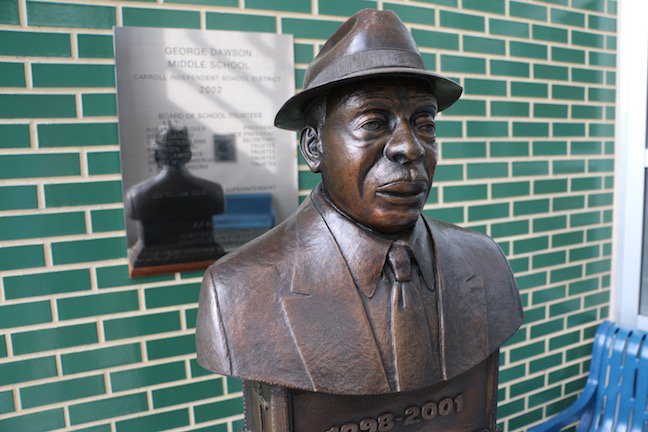
In July 2001, George Dawson died of a stroke at age 103. Today, about a mile from his house is the new George Dawson Middle School. More than 600 students pass George’s statue every day and are reminded of his motto inscribed at the base of the monument: “It’s never too late.”
Fantastic story. I love it.