
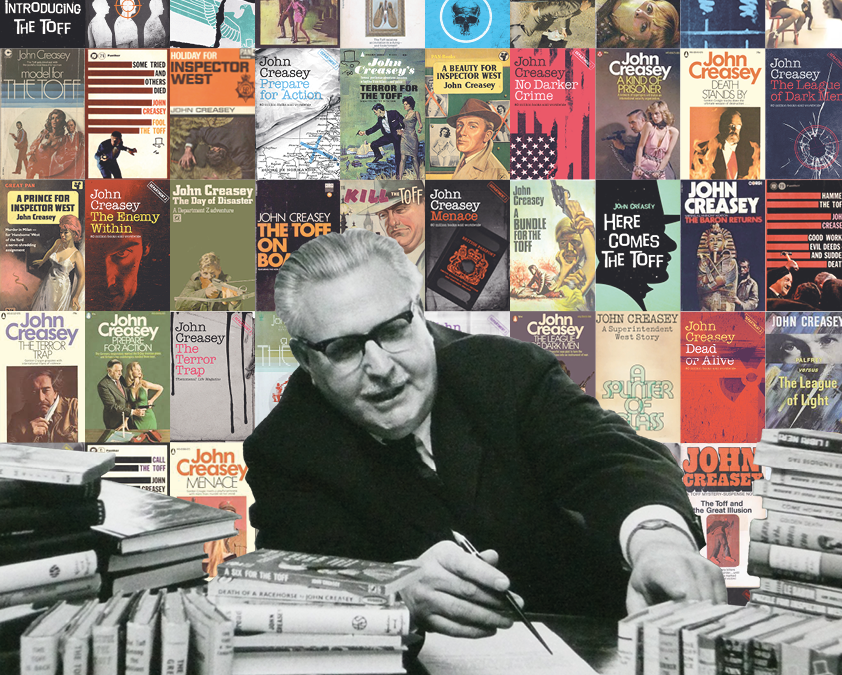
“You may have to fight a battle more than once to win it.” Margaret Thatcher
1930 – London, England: John Creasey checked the mailbox at his small flat in southwest London. He had received another handful of rejection letters regarding his latest novel. Rejection letters, turn-down slips, and “no responses” to his manuscripts had become a game for the 22-year-old grocery clerk and aspiring writer. John filed them away in stacks in his small apartment.
He would show them: His father who laughed at his dream to be a writer, the publishers who turned down multiple novels, and the editors who claimed his characters were boring, “like cardboard cutouts.” The insults and rejections were numerous but only served to fuel his fire.
He grew up on the outskirts of London, the seventh of nine children. His father, Joseph, was a horse carriage maker and part-time carpenter. His mother, Ruth, tended to the children. The family was poor, and life was difficult. It was made more difficult when 2-year-old John had a bout of polio and couldn’t walk until he was 6. He would always walk with a limp.
When John was 10, his teacher at Fulhan Elementary School asked the students to write an essay about their summer vacation. When John received his paper back, the teacher told him, “John, this is very good writing. I think you could be a professional writer when you grow up.”
When John shared his exciting news at dinner, his father laughed. “We aren’t educated people,” Josheph admonished. “We’re working-class people. You need to forget about what your teacher told you.”
Despite his father’s objections, John quit school at 14, hoping to become a writer. He bounced between menial jobs, working in a grocery store, then in sales, as a mailman, and in several factory entry-level jobs. Several employers let him go for neglecting his work to write.
A decade elapsed while John continued to dream, write novels, and get fired from jobs. He never sold a manuscript, but he did collect an astonishing 742 rejections, a number too big to comprehend except that it was later validated by the Guinness Book of World Records.
In 1932, after 12 long and lean years, 24-year-old John Creasey persuaded an independent publisher, Melrose Publishing in London, to take a chance on his first crime novel, Seven Times Seven. It was the young writer’s 10th novel. After the book had marginal success, Melrose published other manuscripts that John had in his files.
At 27, he quit his job in a grocery store to become a full-time writer, determined to prove his critics wrong. John cranked out novels so fast that English booksellers complained he left little room on the shelves for other authors in his genre. His solution was to crank out books under various pen names.
John was an incredibly prolific writer who published books at an astonishing rate. He wrote 6,000 to 7,000 words per day, sometimes logging 12 hours of writing in a day. He used an ambassador typewriter equipped with three extra keys that enabled him to type dialogue faster.
Because of his childhood polio, John was rejected for military service during WWII. He contributed to the war effort by obsessively writing 144 books between 1940 and 1945 to entertain British civilians and troops. It wasn’t unusual for him to write a book a week. John wrote crime fiction, science fiction, mysteries, espionage thrillers, Westerns, and even romance novels.
In 1962, his book Gideon’s Fire won the prestigious Edgar Award from Mystery Writers of America, and it was judged the best novel of the year in the U.K. It remains one of the 100 best crime novels ever written. In 1969, Mystery Writers of America awarded John its highest honor, the Grand Master Award. He served one term as president of the MWA, the first non-American to do so.
Later, John founded the Crime Writers Association of Great Britain and served as president for a time. Each year in honor of him, the organization presents a First Novel Dagger Award to recognize first books by previously unpublished authors.
Shortly before his death in 1973 at age 65, a New York Times reporter asked John Creasey, considering his success, why he continued to write 6,000 words per day. He pointed to his 10 years of rejections. He still had something to prove.
Today, more than 50 years after his death, John Creasey still appears on the most prolific authors of all time lists. He published 620 books over a 40-year career, and his books have sold more than 80 million copies in 28 languages, with sales in over a 100 countries. The man who collected more rejections that anyone in recorded history persevered and spent his career churning out books with factory-like productivity.
Great story. Lot of hard work finally paid off.